V3 Solver Tuner and Solver V3.2
The Solver Tuner is a new feature that gives users control over how the v3 network solver determines which wells to curtail when a constraint is active. Prior to this release, the v3 solver used a fixed internal ranking algorithm, which could produce curtailment results that differed from the v2.8 solver in ways that were difficult to reconcile.
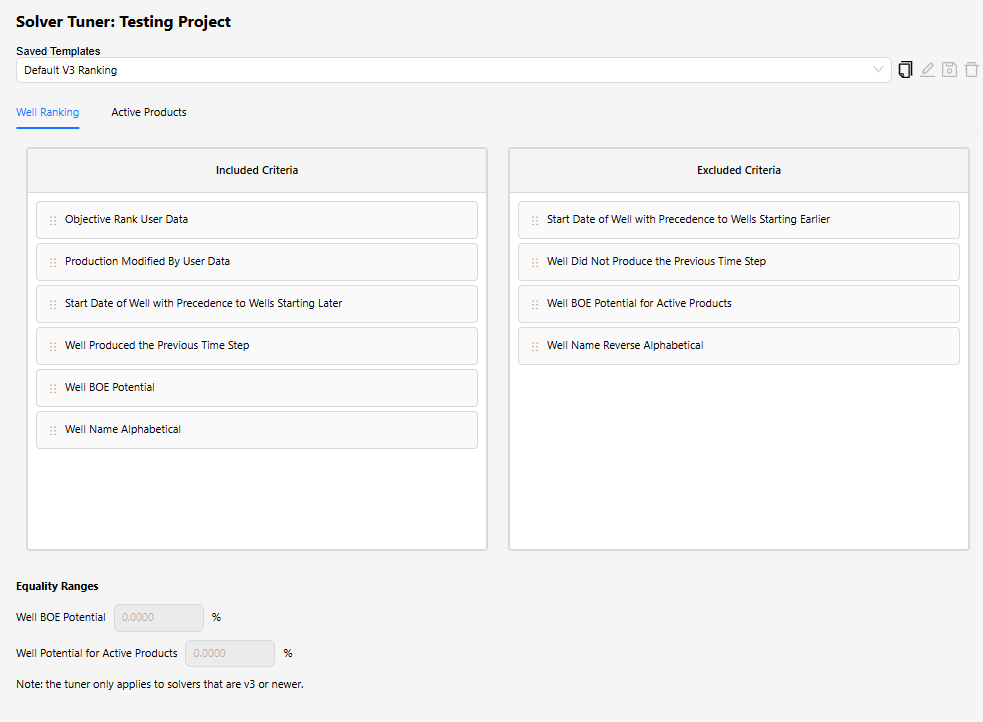
The Solver Tuner allows users to configure the ranking criteria the solver uses — including asset start date, previous rate of take, production potential, active product type, and well name — and to enable or disable each factor individually. Criteria can be reordered to reflect the user's preferred priority sequence, and an optional equality threshold can be set so that wells whose values fall within a specified percentage of each other are treated as equivalent, causing the solver to fall through to the next criterion rather than making an arbitrary choice between near-identical candidates. Settings apply at the project level and are shared across all scenarios. Named setting templates can be saved, loaded, and renamed, making it straightforward to switch between configurations or share a standard tuning setup across projects. The Solver Tuner can be found in Project Options in the Network Solver Settings section.
In addition to the Solver Tuner, 2.17.3 also introduces Solver V3.2, which becomes the new version behind the "V3 Latest Optimizer (Recommended)" option — meaning any project already set to V3 Latest will automatically use V3.2 without requiring any user action. Users who want to pin to a specific version can still explicitly select V3.1 or V3.2 from the solver dropdown in Project Options; projects with an explicit version set will not change.
The primary improvement in V3.2 is a more deterministic well ranking sort order during curtailment. In V3.1, when two wells had near-identical values for a given ranking criterion, the tie-breaking behavior was inconsistent between timesteps, which manifested as production "jumping" between wells from one period to the next. V3.2 makes the sort order more stable, eliminating this oscillation. As a side effect of this change, users upgrading from 2.17.2 may notice small numerical differences in PDS output compared to the prior version — this is expected and reflects the improved determinism rather than a calculation error.
Two bugs resolved in V3.2 are also worth noting: a crash that occurred when the solver encountered a terminal node with no terminal products during diamond removal in the network has been fixed, and the previously noted production-jumping issue between identically-declining wells under a constrained downstream facility has been resolved.